PORTRAIT & ORIGINAL FICTION
Arianna
Sinn
Partner brands






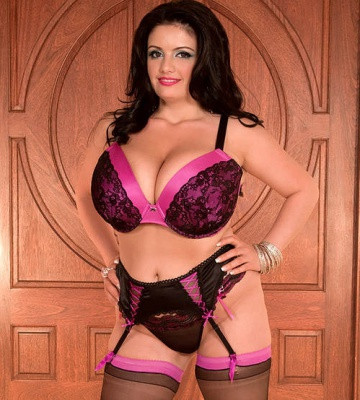
Arianna Sinn performs under that name, and this independent collection builds her portrait from a single complete photograph. She stands against a carved wooden door in a fuchsia top, black fabric and garter stockings, dark hair loose around her face and both hands resting at her hips. Nothing in the frame is cropped away. Around that image sit a short visual essay called Fuchsia and Wood and two original fictions, The Third Echo and The Borrowed Dawn, which imagine her in rooms that exist only on the page.
Visit work archiveArianna Sinn
A name and an original portrait
The photograph arrived with the public name and nothing else attached: no photographer credit, no session date, no location. What it does show is clear enough. Fuchsia gathers at the top of the frame while black fabric and stockings hold the lower half, and the door behind her supplies a warm brown field of carved curves and straight panels. Her smile and the set of her hands give the pose its own composure, and the essay reads those details as composition rather than as clues to a private life.
Fuchsia and Wood stays close to what the camera recorded. It looks at how one saturated colour holds its ground against the dark fabric, and at how the door's large curves repeat at a smaller scale in the folds and outlines of the figure. The two stories take a different route. The Third Echo sends an invented Arianna to a doorway where a knock returns three times, and The Borrowed Dawn follows a line of reflected light across a rehearsal room. Both are fiction, with invented rooms, objects and endings; neither claims a real journey, a stage career or a private occasion.
The name and the whole frame
Arianna Sinn appears here under a public performer name, with one complete photograph as the anchor. Keeping the frame whole matters: the standing figure, the hands at her hips and the carved door all belong to the same composition, and the lines of the background run to its edges without being cut short.
Two temperatures
Fuchsia gives the picture its sharpest note, and the black fabric and stockings settle the lower half into something quieter. The door answers with warm brown and a set of carved arcs that rhyme with the smaller curves of the pose. Fuchsia and Wood keeps to that exchange of colour and line and leaves the photographer's intentions alone.
Two invented rooms
The Third Echo and The Borrowed Dawn work in a different register. One listens for a sound that arrives after the others; the other follows a strip of reflected light to a corner the window never reached. Both stories invent their rooms, objects and endings, and neither asks to be read as a record of a real journey or a working life.